
The Mistake Everyone Makes First
The door starts making a new noise, or it looks a little crooked when it's down, and one spouse says, "It's just the rollers, I'll grease it this weekend." The other spouse isn't so sure. The grease-it theory wins almost every time because it's cheap, it's easy, and the door still opens and closes like normal. That's exactly why it's tempting — and exactly why it's wrong often enough to matter.
Here's the problem: a worn roller and a frayed cable can sound almost identical from inside the garage. Both show up as grinding, jerking, or a door that doesn't glide the way it used to. But one of those problems is a maintenance item. The other is a safety hazard that gets worse every time the door cycles. Guessing wrong means either wasting money on parts you didn't need, or ignoring a cable that's one cold morning away from snapping under spring tension.
What the Cable Is Actually Doing
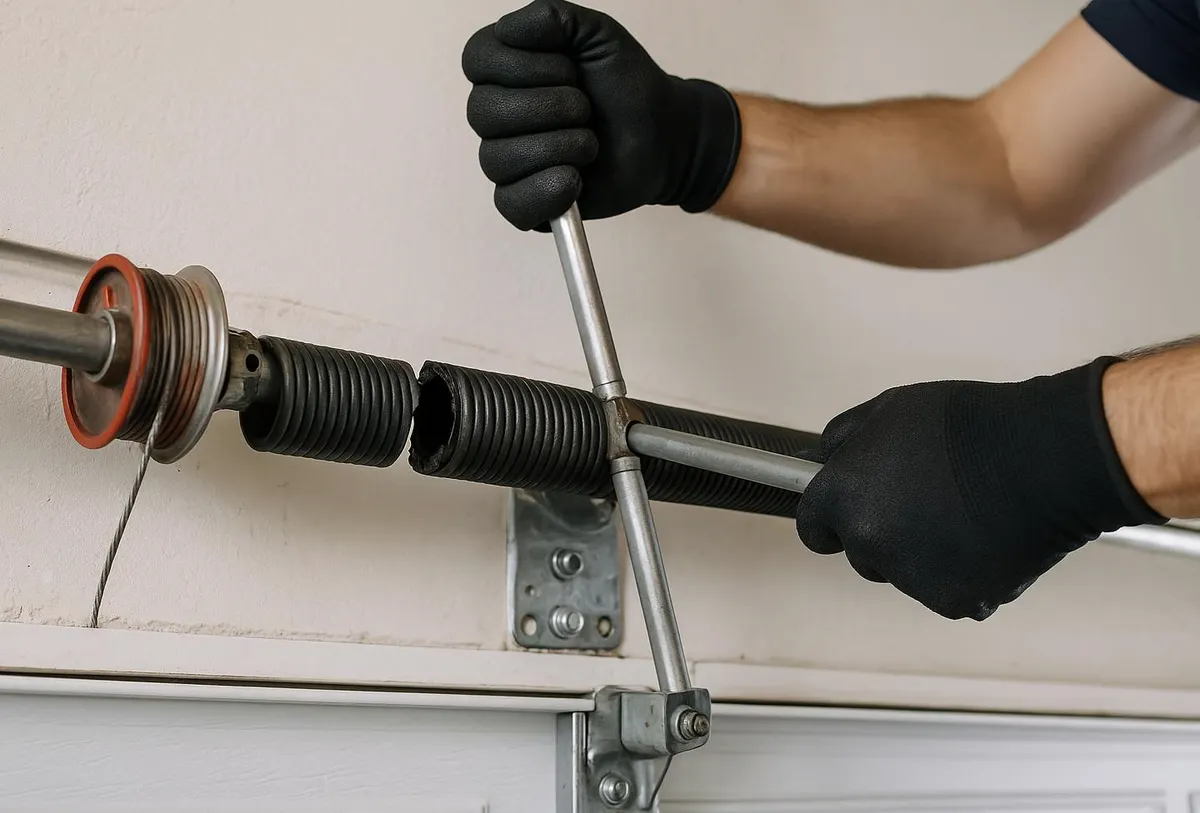
Garage door cables aren't decorative. They work with the torsion or extension springs to carry the full weight of the door every single time it moves. When you hit the opener button, that cable is under serious load, wound tight around a drum or looped through a pulley near the bottom bracket. A fraying cable is a cable that's losing strands one at a time — and each lost strand means the remaining strands carry more weight than they were built for.
In a hot, humid climate like ours, cables take extra abuse. Moisture works into the strands and causes surface rust, which makes the metal brittle at exactly the spots where it flexes around the drum or pulley. You'll often see the fraying start near the bottom bracket, where the cable gets pinched and re-tensioned every time the door closes.
This matters even more heading into storm season. Garage doors here are built and installed to meet wind-load expectations so they can resist the pressure differences that come with tropical storms and hurricanes. A big part of that wind resistance depends on the cables and springs holding the door firmly in its track under load. A frayed cable doesn't just risk a snap on a normal Tuesday — it quietly reduces how much wind pressure that door can actually take before it fails.
What the Roller Is Actually Doing
Rollers are simpler. They're the wheels that ride inside the track and let the door glide up and down. Over years of use — especially with afternoon downpours pushing humidity into the garage and swelling wooden door panels or frames — rollers wear down, their bearings dry out, or they start riding at a slight angle inside the track. That's what produces the classic grinding or rattling sound, and it's also what makes a door feel like it's catching or jerking at certain points as it travels.
Worn rollers are annoying and they do stress other parts of the system over time, but they're not usually dangerous in the way a frayed cable is. A roller failing typically means the door gets harder to move, sticks in the track, or pops off the track slightly. It's rarely the sudden, high-energy failure you get from a cable under tension letting go.
How to Tell Them Apart, Safely
Here's the checklist that actually settles the argument:
- Look at the cable, don't touch it. With the door fully closed and the opener unplugged, shine a flashlight at the cables running down each side near the bottom corners. You're looking for individual broken strands poking out, a "fuzzy" or frayed section, or rust buildup that looks flaky rather than just surface dust.
- Check if the door hangs level. Stand back and look at the bottom edge of the closed door. If one side sits noticeably lower than the other, that's often a cable or spring issue, not a roller issue.
- Listen for where the noise happens. A grinding or squeaking sound that happens the whole way up and down usually points to rollers. A sudden pop, bang, or a moment where the door jerks hard at one specific point often points to the cable or spring system.
- Check the rollers themselves. With the door open, you can often see the rollers at the edges of the panels. Cracked, chipped, or visibly worn-down nylon rollers are a straightforward part swap.
- Never put your hands near the cables, drums, or springs. This is the one firm rule. These parts are under continuous high tension, and a cable or spring that looks fine can still let go unexpectedly when disturbed. Rollers are a reasonable DIY check and even a DIY swap for a handy homeowner. Cables are not.
The Trade-Off in One Sentence
Rollers are a maintenance cost you can put off for a while; cables are a safety item you shouldn't put off at all — especially with storm season bringing wind loads that rely on that cable doing its job correctly.
When to Call Lake Butler Garage Door Pro
If you've spotted frayed strands, rust pitting on a cable, or a door that hangs crooked, stop opening and closing it and give us a call. Our Cable & Roller Replacement service covers exactly this situation — we release the spring tension safely, swap out worn cables and rollers together (since they wear as a system), and make sure the door is balanced and tracking straight again. If the inspection turns up spring wear too, that's where our Garage Door Spring Repair service comes in, since cables and springs are really one connected system and replacing one without checking the other is how you end up back here in six months.
If you're in Lake Butler, Starke, Worthington Springs, Brooker, Alachua, High Springs, Keystone Heights, or Macclenny and you're not sure whether it's the rollers, the cables, or both, don't guess — call Lake Butler Garage Door Pro and we'll settle the argument for you, with a straight answer and a fix that lasts.